PE coated film is widely used in packaging, insulation, and industrial composites for its moisture resistance, heat-sealing capability, and versatility. Extrusion coating is a common process for applying polyethylene (PE) to different substrates to achieve specific material properties.
Pengyuan Group provides customized PE coated film solutions with different material structures to meet diverse application requirements. By selecting suitable substrates and coating configurations, customers can develop composite materials tailored to their processing and performance needs.
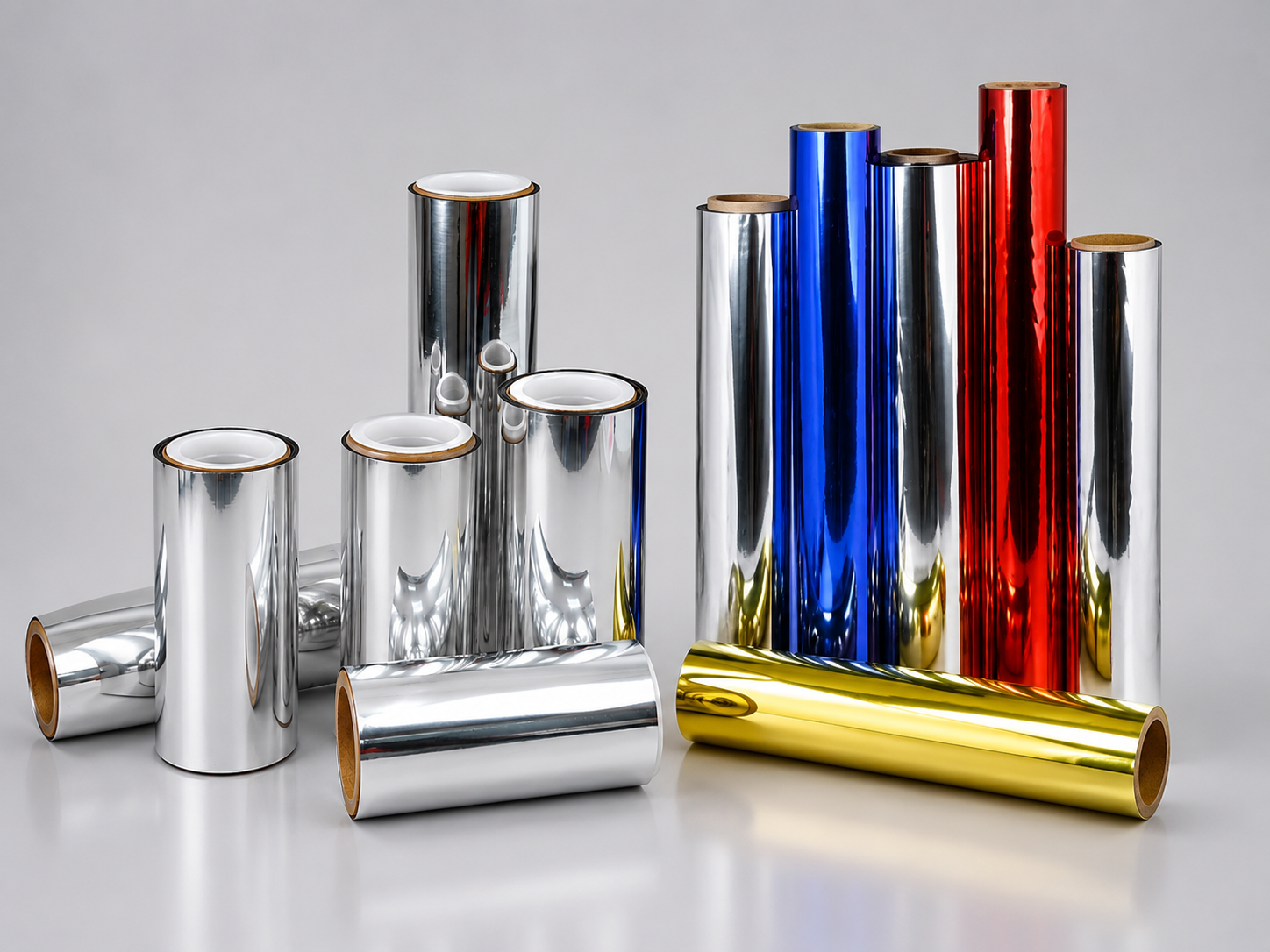
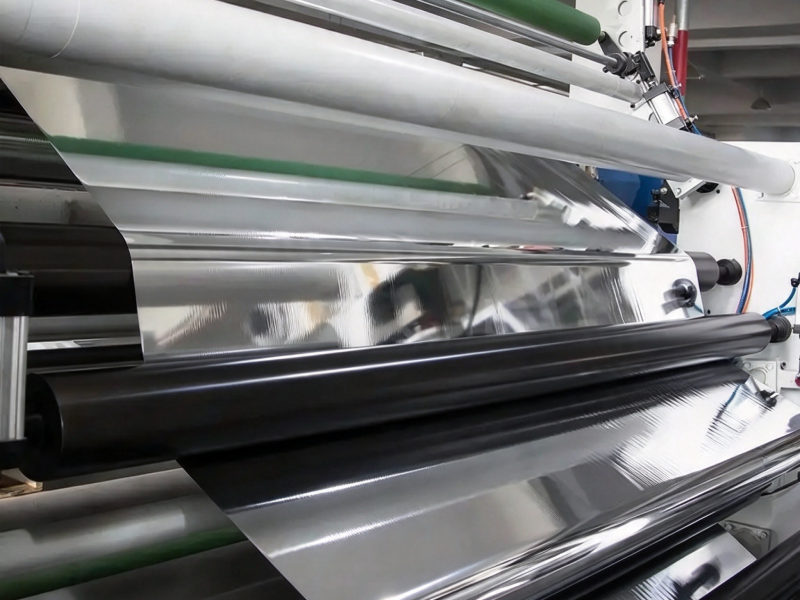
Extrusion coating is a manufacturing process in which molten thermoplastic resin is extruded through a flat die and applied directly onto a moving substrate. The coated material then passes through a pressure nip, where it is pressed against a cooling roll to solidify the polymer and establish the required surface characteristics.
Polyethylene is commonly used because it offers moisture resistance, flexibility, and heat-sealing capability. Depending on the application, extrusion coating can be applied to paper, paperboard, aluminum foil, plastic film, woven fabric, and nonwoven substrates.
Unlike conventional adhesive lamination, extrusion coating uses molten polymer as the coating material and, in many applications, as the bonding layer between substrates.
The process combines polymer melting, coating application, bonding, and cooling. PE resin is heated inside an extruder until it reaches a suitable molten state. The polymer then passes through a flat die and forms a thin curtain across the width of the moving substrate. As the substrate and molten polymer enter the nip between the pressure roll and cooling roll, the PE layer is brought into contact with the substrate and begins to solidify.
The resulting coating depends on several factors, including resin grade, substrate properties, coating thickness, processing temperature, and production speed. Proper control of these variables helps maintain coating uniformity, adhesion, and finished-product consistency.
Extrusion coating is particularly useful when a substrate needs additional moisture protection, heat-sealing functionality, or a polymer surface suitable for subsequent converting operations.
PE coated film refers to a film or composite material incorporating a polyethylene coating layer. Depending on the manufacturing method and product design, the PE layer may serve as a protective surface, a heat-sealing layer, or a bonding layer between different materials.
The term can describe different structures. In some products, PE is extruded directly onto a substrate. In others, a PE layer is combined with a film or another material as part of a multilayer composite.
For this reason, buyers should evaluate the actual material structure and production method rather than assuming that every PE coated film is manufactured in the same way.
Moisture Resistance
Polyethylene provides a useful barrier against liquid water and water vapor. The actual moisture barrier depends on the coating thickness, substrate, pinholes, edge conditions, and overall composite structure.
Heat-Sealing Capability
Suitable PE grades can form heat seals under controlled temperature, pressure, and dwell time. This makes PE coated materials useful for packaging and other products that require sealed edges or joints.
Flexibility and Processability
PE is flexible and can accommodate many converting operations, including cutting, folding, forming, and lamination, provided the selected structure is compatible with the process.
Surface Protection
A PE layer can protect the underlying substrate from direct contact with moisture and help improve its suitability for handling and downstream processing.
Composite Material Compatibility
PE coating can combine with substrates that provide complementary properties. For example, a metallized film can contribute reflective properties and barrier performance, while the PE layer can provide heat-sealing or thermal bonding functionality.
The extrusion coating process begins with selecting a suitable substrate, such as paper, aluminum foil, polyester film, metallized film, or woven and nonwoven materials. The substrate must have appropriate surface characteristics and dimensional stability to ensure consistent coating and adhesion.
Polyethylene resin is melted in an extruder and distributed through a flat die onto the moving substrate. The coated material then passes through a nip between a pressure roll and a cooling roll, where the molten PE bonds to the substrate and solidifies into a continuous coating. Depending on the materials involved, surface treatment or additional bonding measures may be required.
Key process parameters, including melt temperature, coating thickness, web speed, and cooling conditions, influence coating uniformity, adhesion, and finished-product performance. After coating, the material can be inspected, slit, wound, or processed further according to its intended application.
Extrusion coating and adhesive lamination are both used to manufacture composite materials, but they differ in how the layers are combined.
| Comparison Factor | Extrusion Coating | Adhesive Lamination |
|---|---|---|
| Bonding material | Molten thermoplastic resin | A separate adhesive |
| Application method | Polymer is extruded directly onto a moving substrate | Adhesive is applied between layers |
| Main process requirements | Extrusion, coating, nip pressure, and cooling | Adhesive application, web alignment, and curing or drying as required |
| Potential functional benefits | Can provide a PE surface, heat-sealing capability, or a bonding layer | Can combine materials with different functional properties |
| Material selection | Requires a suitable extrusion resin and compatible substrate | Requires a suitable adhesive and compatible surfaces |
| Cost considerations | Depends on resin use, line efficiency, coating weight, and substrate | Depends on adhesive, curing requirements, equipment, and production conditions |
Neither method is universally better. The appropriate choice depends on the material combination, performance requirements, production volume, processing equipment, and total manufacturing cost.
PE coated film serves a range of industrial applications because it can add moisture resistance, heat-sealing functionality, or a compatible bonding surface to an existing material.
PE coated materials are used in packaging structures that require moisture protection, sealed edges, or compatibility with converting processes.
For these applications, buyers should evaluate the complete structure, including the substrate, coating thickness, sealing conditions, and required barrier performance.
PE coated metallized film combines a metallized substrate with a polyethylene coating layer. The metallized surface can contribute reflective properties and barrier performance, while the PE coating can support heat sealing or thermal bonding.
Depending on the product design, these materials can be incorporated into packaging structures and composite materials for insulation-related applications.
Explore Pengyuan Group's Metalized Film Coated PE for product-specific information.
PE extrusion coating can improve the resistance of paper-based materials to moisture and provide a polymer surface for sealing or other downstream operations.
The suitability of a coated paper structure depends on the intended use, coating weight, paper characteristics, and required converting performance.
In multilayer insulation products, PE can function as a bonding or protective layer between compatible substrates. Its role depends on the overall structure and the thermal, mechanical, and environmental requirements of the finished product.
For metallized insulation composites, material selection should consider the properties of the complete assembly rather than evaluating the PE layer in isolation.
PE coating can be applied to suitable woven and nonwoven substrates to improve moisture resistance or provide a surface for additional bonding and fabrication processes.
The substrate construction, coating uniformity, flexibility, and adhesion requirements should be considered together when developing a material for industrial use.
Different applications require different combinations of substrates, coating materials, and functional properties. A PE coated film designed for packaging may have different structural requirements from a composite material intended for insulation, protective packaging, or industrial lamination.
Pengyuan Group provides customized manufacturing of PE coated film products in a range of material structures to meet different application requirements. Rather than limiting customers to a single standard construction, the company can discuss suitable material combinations and coating configurations based on the intended use and required performance.
For customers seeking metallized PE coated materials, Pengyuan Group's Metalized Film Coated PE provides a starting point for evaluating product suitability. Other customized PE coating structures can be discussed according to specific technical and production requirements.
 0571-88778588
Company Name:Zhejiang Pengyuan New Material Co., Ltd.
Address:No.2-9 Anxi Road, Liangzhu Street, Hangzhou 311113, China
Email:info@pengyuangroup.com





 Tel
 WhatsApp
 Top